

In pediatrician waiting rooms, a certain scene frequently occurs. With a tablet in hand and what the box refers to as a “educational” alphabet software, a toddler sits next to a parent. The kid is able to swipe to the following letter. When asked, they tap the appropriate animal. The app gives a chime of approval. The parent observes and sensibly believes that something beneficial is taking place. The youngster is involved. They appear to be picking up knowledge. The letters appear directly on the screen.
What the chime doesn’t convey is what early language acquisition research has consistently shown for years: passive letter recognition on a flat screen has very little to do with how very young children actually develop the cognitive architecture for reading, writing, and verbal communication. The back-and-forth of discussion, a caregiver’s contingent response that modifies their words in response to a child’s reaction, and the tactile experience of touching, holding, and manipulating real-world things are all aspects of human connection. A two-year-old can learn to tap the letter A when it appears by using an alphabet app. When it comes to creating the brain connections that would eventually enable children to read, it is far less successful.
The reason for this is quite evident in the studies on language development. The most effective way for young children to acquire language and letter concepts is through what developmental experts refer to as serve-and-return interaction: a child points at something, a caregiver labels it, the child responds, and the caregiver makes adjustments. A toddler develops language in a way that one-way content cannot match when that loop is repeated thousands of times during their waking hours. Information is displayed on a screen. It doesn’t react to the youngster in front of it by observing their attention, reading their perplexity, or changing the explanation. All of those actions are conducted without conscious thought when a parent reads aloud from a picture book.
For this age range, tactile learning is more important than parents are typically urged to recognize. When a youngster writes in sand, handles a foam letter puzzle, or traces the shape of a letter in playdough, they are simultaneously developing the spatial memory of that letter’s form through several sensory channels. Compared to visual recognition alone, that multisensory encoding is more robust. On a screen, the letter A is merely a shape that may be tapped. The child’s hands are familiar with the letter A pressed into playdough. The difference is significant because it illustrates how learning is actually consolidated in very young brains.
The issue that most often surprises parents is self-regulation. When a tablet is used as the go-to tool for handling challenging toddler situations, such as leaving the park, waiting at a restaurant, or being fussy before dinner, the child is being assisted rather than learning how to handle those situations. In the short run, that seems like a fair trade-off. However, the ability to endure annoyance, switch between tasks, and sit through boring or slow content are all talents that require experience, and practice necessitates the difficult moment. A toddler who regularly uses a screen to ease their discomfort loses out on a lot of those practice chances.
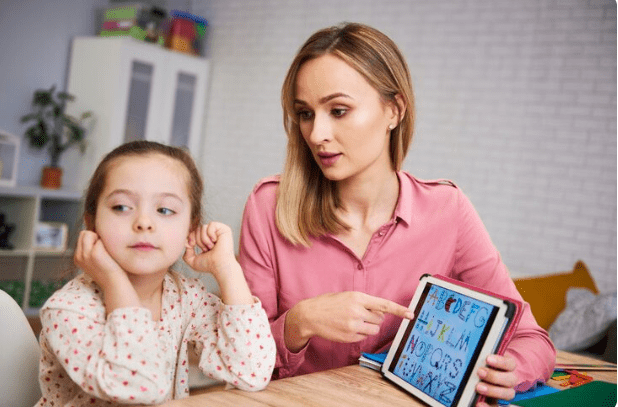
All of these does not support treating a tablet as a categorical hazard or parental perfectionism. There are situations where screens provide real interactive needs for young children, such as video conversations with family members, and it is conceivable to use a gadget periodically without suffering significant developmental harm. The gadget in a home is not the issue. It is the replacement of screen-based content with the things that truly foster early literacy, such as real books with big letters, repeated singing of the alphabet, discussions about the letters on a store sign or cereal box, and the straightforward experience of spending time with a patient adult who speaks to a child as though the words they are exchanging matter. They do. That’s the entire mechanism, to put it mildly.
