

A little child looks at her mom while holding out a design of a slightly crooked house, sun in the corner, and crayon on paper. The parent is using a phone. not taking any urgent action. simply scrolling. The child waits, holds the drawing a little higher, and then quietly sets it down. Sweden’s Public Health Agency has chosen to approach that moment, which is repeated every day in millions of households, as a public health concern—not the child’s screen time, but the parent’s.
A significant change in the way a national health organization has framed the digital issue may be seen in Folkhälsomyndigheten’s new guidelines on screen use in family settings. The majority of public discussions on kids and technology center on what kids watch, how long they watch it, and what platforms they use. Sweden takes a different approach, focusing on the adult in the room and what happens to a toddler’s growing brain and emotional well-being when that adult is regularly absent, even when they are physically present. Studies examining parent-child interaction in homes with heavy smartphone use have long reported these consequences, thus the science supporting the recommendations is not new. The government agency’s clear statement that parental scrolling poses a health risk to children, expressed in specific educational language, is novel.
What developmental psychologists refer to as a “bid for attention”—the brief, recurring instances in which a very young kid reaches out to a caregiver for recognition, connection, or a shared experience—is the mechanism at the heart of the issue. A young child pointing out a window at a bird. transferring a block. making a noise and checking to see if it touched down. A young child’s perception of whether their communication matters, whether they are worthy of attention, and whether the outside world is responsive to them is shaped by the caregiver’s response—or lack thereof—to these bids, which occur continuously throughout the child’s waking hours. A large percentage of these bids are missed by a parent who is engrossed on their phone. The youngster doesn’t know why. They have an accumulation of experiences that seem to be invisible.
In the studies, the missed interaction most clearly manifests itself in language development. Face-to-face interaction, such as taking turns in conversation, the caregiver describing the surroundings, and the back-and-forth that gives a child not just words but also a social understanding of how communication works, is crucial to early language acquisition. Early language outcomes are substantially different in households where adult phone use regularly disrupts this conversation. Not significantly, in a single exchange. When conversational quality declines over months or years, the effect can be seen in developmental evaluations.
Perhaps the most unsettling aspect of the advice for parents who devote a lot of time to controlling their kids’ screen usage is Sweden’s behavioral modeling argument. Children learn how to interact with technology mainly by observing the adults who are closest to them, according to a reasonably consistent body of studies. A youngster is always learning about how people interact with technology in a home where a parent is clearly and frequently engrossed in their phone—checking it automatically during quiet times, scrolling through transitions, and leaving it on the table during meals. No formal rule, no matter how well-stated, can last as long as that lesson.
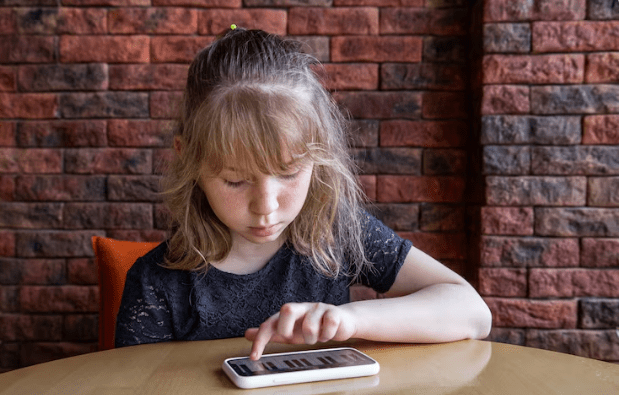
In contrast to public health guidelines, the guidelines’ precise directions are straightforward. During designated child contact time, phones should be hidden rather than just turned off or turned face down. Everyone in the home is prohibited from using electronics in the dining room and bedrooms. A tangible privacy measure that recognizes the digital footprint that parents are leaving for children who are unable to give consent is to pause before uploading pictures of youngsters online. Guidance that tells parents what to do rather than asking them to “reflect” on their habits has an almost enlightening quality. It has to be seen if this directness results in significant behavior change on a large scale. However, the framing itself—that the adult’s phone is the root of the issue—represents a change that seems long overdue.
