

The majority of discussions around kids and screens center on what kids are seeing, how long they are watching it, and what device they are using. The focus has been changed by Sweden’s public health ministry in a way that seems both apparent in hindsight and really understudied: the issue isn’t only what kids are doing with screens. It’s what the grownups in their immediate vicinity are doing.
It was stated clearly in the agency’s revised guidelines by Helena Frielingsdorf, a psychiatrist and researcher at Folkhälsomyndigheten in Sweden. According to her, children are impacted “not only by what adults say, but also by what adults do.” It sounds like a straightforward observation. The consequences are not. The discussion about child development and digital technology cannot remain focused on children’s own device use without addressing the household environment that shapes it if children pick up screen habits from the adults they live with, as the research Sweden commissioned specifically to look into this found.
Instead of being aspirational, the agency’s direction is specific. When you are with your youngster, put your phone aside. Use it only when necessary or in conjunction with them. Establish phone-free areas throughout the house; the dining room and bedroom are two examples. Don’t share images or videos of kids online without considering the implications for their digital identity and privacy. This is not a list of general guidelines for moderating. It is a list of particular everyday behaviors associated with particular locales.
Sweden has already set some of the most explicit rules for children’s screen usage in Europe: no screens at all for children under the age of two, one hour per day for those between the ages of two and five, two hours for those between the ages of six and twelve, three hours for teens, and no screens in bedrooms at night. These rules applied to kids. The new guidelines are specifically targeted at adults because research has shown that children of heavy screen users tend to develop similar tendencies, and that parents’ screen time may have a negative impact on the quality of their relationships with their kids. The relationship is not just about what kids see on a computer; it is both behavioral and contextual.
The ban on smartphones in schools in Sweden, which will go into effect in the fall of 2026–2027, has received a lot of attention. It applies to all students through Grade 9, which means kids up to the age of fifteen or sixteen, and it is incorporated directly into the Education Act rather than being a school-by-school policy decision. One aspect of the issue is addressed by that measure. Another is addressed by the home environment. The revised parental instructions indicate that Sweden views this as a problem that affects the entire environment rather than just classrooms or kids’ bedrooms.
The Swedish Minister of Social Affairs, Jakob Forssmed, told the public broadcaster SVT that he believes most people are unaware of how much screen time impacts their kids. The new guidelines aim to bridge the gap between what current research indicates and what parents intuitively understand. For the past two years, the organization has advised parents and guardians to “reflect” on how they use their smartphones when around kids. Reflection gives way to advice in the revised guidelines. The change in wording is important: promoting a particular behavior is instructing people what to do, whereas proposing reflection is asking them to think about something.
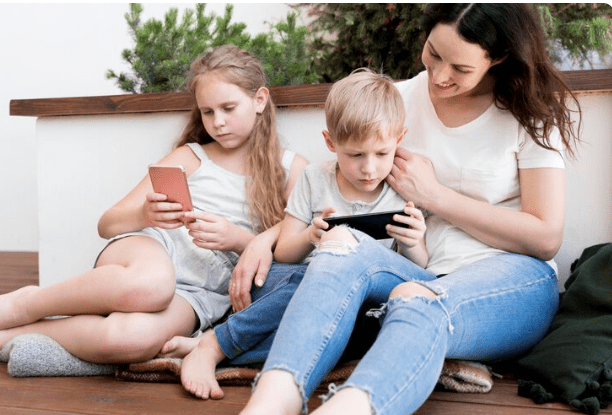
The portion that is easiest to ignore is Frielingsdorf’s observation regarding minor adjustments in daily living. The study indicates that there are quantifiable quality variations in those encounters and that these disparities accrue, but it does not conclude that parents who use their phones around children are causing long-term harm. It’s not a huge gesture for a parent to put their phone face down during supper. Simply put, their presence differs qualitatively from their partial absence. With institutional authority, Sweden is now stating that it is worthwhile to make that distinction.
