

The theater stops when Bonnie, an eight-year-old girl, turns to her parents early in Toy Story 5 and asks, softly, “Why won’t anyone be my friend?” Not because of the theatrical weight with which the line is delivered. But because it is so obviously, unmistakably real. The parents occupying those seats have previously heard that question in one form or another. Perhaps not aloud. Perhaps simply in the way a child looks after school. That kind of discomfort is not what a cartoon is meant to evoke.
That is the main accomplishment of Toy Story 5, which was directed by Andrew Stanton, the Pixar veteran behind Wall-E and Finding Nemo, and released in June 2026. On the surface, the movie is just another entry in a series that started with a shiny space ranger and a pull-string cowboy more than thirty years ago. Beneath the recognizable voice cast and the pastel-bright animation, however, it is doing something that none of its predecessors tried quite so directly: reflecting the unique, everyday anxiety of raising a child in the digital age. It is not a flattering reflection.
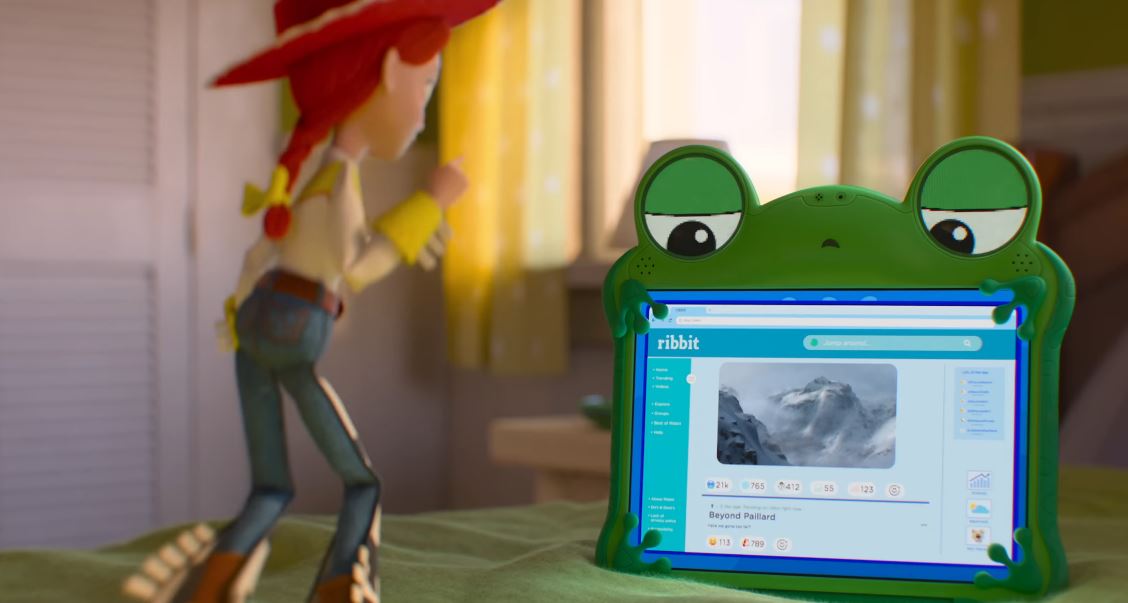
The setup is fairly simple. Bonnie longs to connect with the girls in her dance class despite her shyness and social isolation. As millions of real parents do every year, her parents decide to buy her a tablet after witnessing her struggles. It’s called Lilypad in the movie, and Greta Lee gives it a cheerful menacing voice.
It looks like a friendly frog and is marketed as a way to connect kids online. Instead, it draws Bonnie away from her toys, from physical play, and from the creative realm that Pixar has always revered. The toys, Jessie, Buzz, and a momentarily reappearance of Woody, observe this and are powerless to stop it. The true horror of the movie is that helplessness, which is solely the responsibility of the viewers’ parents.
| Toy Story Film | Core Fear Explored | Who It Hurts Most |
|---|---|---|
| Toy Story (1995) | Replacement, jealousy between toys | Children anxious about change |
| Toy Story 2 (1999) | Being forgotten, abandonment | Older kids and nostalgic adults |
| Toy Story 3 (2010) | Growing up, letting go | College-age viewers and their parents |
| Toy Story 4 (2019) | Purpose, identity after usefulness ends | Adults in transition |
| Toy Story 5 (2026) | Digital displacement of childhood | Parents of school-age children |
It is worthwhile to take a moment to consider those parents. 1995 saw the release of the first Toy Story. Many of the kids who watched Woody fall out of a moving van in theaters are now in their mid-thirties to early forties, and many of them have their own eight-year-olds.
Pixar knows this. There is a purpose behind the generational math. When a parent watches Toy Story 5, they are watching it as someone who grew up with these characters, who remembers the unique joy of physical play, and who, while carrying a smartphone in their pocket, is now attempting to prevent their own child from having access to that same thing. There is a lot of guilt associated with that position, and the movie does not ignore it.
Lilypad is not a villain in the traditional sense, which is why she is such a powerful antagonist. She doesn’t plot or make threats. She merely provides a glowing screen full of games and social networks, as well as convenience and connection. With all the conviction of a parent who has made up their mind, Jessie challenges her. Lily’s counterargument—that she helps kids who might not have anyone else—is not completely disregarded.
The movie is astute enough to recognize the true allure of screens for lonely children. When a child with social anxiety can join a group chat and feel like they belong, they are not being harmed in any straightforward way. The extent to which that digital connection replaces something rather than enhances it is the issue, according to Toy Story 5. Bonnie puts down her game. She gives up daydreaming. She looks.
The movie has a lingering visual sequence. From the toys’ point of view, Bonnie’s fantasy world is depicted using layered pastels, textures that resemble handmade items, and colors that change and pulse according to her mood.
In contrast, the Lilypad games are uniform and flat. The kind of brightness that illuminates without warming anything is somehow hollow. It’s an honest distinction, but it’s not a subtle one. The movie doesn’t pretend that screens are inherently bad. It is arguing, more precisely, that the texture of scrolling differs from that of imagined play and that something is lost when one completely replaces the other.
This time, Jessie assumes the primary role that Woody held for the first four movies, bearing the majority of the emotional burden. Woody does make a comeback, but he primarily serves as support now that he has a bald spot and a softer silhouette.
In Toy Story 4, his storyline focused on gracefully embracing irrelevance. This theme is taken up and expanded upon in Toy Story 5, where the toys are facing something more akin to erasure rather than just obsolescence. In contrast to a more recent toy, Lilypad does not replace them. She makes the whole physical toy category seem irrelevant. The transition from obsolescence to irrelevance is significant. That might be the most unsettling concept in the entire movie.
The film Toy Story 5 is not flawless. Fifty identical Buzz Lightyear action figures are involved in a subplot that feels like a separate movie inserted into this one. In the second act, the pace slows down. After being introduced with seeming enthusiasm, some of the supporting toys vanish without explanation.
At this point, the franchise has a lot of weight, and not all of it is shared equally. However, in a sense, the film’s messiness is justified because it deals with a truly messy subject. How much screen time an eight-year-old who is shy should have is a difficult question. There isn’t a single Lilypad version that is just incorrect and unbeatable. Toy Story 5 does not punish the parents who gave Bonnie the tablet because they made a loving and reasonable decision under duress.
Watching this movie gives you the impression that Pixar stumbled into something more serious than it had intended. Australia has passed legislation prohibiting minors from using social media, and the UK is reportedly following suit. Government policy is now the topic of discussion when it comes to kids and screens instead of pediatric recommendations.
Toy Story 5 speaks to the shift in a particular emotional register that only a tale about a lonely child can, but it didn’t cause it; rather, it came at the exact moment it was taking place. Perhaps the most honest thing a family-oriented movie has done in years is to sit inside the discomfort long enough for parents to identify with it, rather than providing solutions.
