

Over 16 million copies of Ring Fit Adventure have been sold. For more than ten years, Just Dance has been a mainstay in living rooms. Families that purchased the Nintendo Switch Sports because it looked like a fair compromise—some engagement, some physical activity, and less guilt about screen time—have it on their shelves. The kids aren’t simply sitting; they’re moving and having fun, which makes the pitch genuinely enticing. What is the issue?
The discrepancy between these games‘ appearances and their actual content is the issue. A child playing real tennis and a child swinging a Joy-Con controller to imitate tennis are two activities that seem similar but aren’t in the ways that are important for physical development. Running, direction changes, reading an opponent, and body position adjustments in three dimensions under physical pressure are all part of real tennis. In the controller version, you move your wrist in a living room. Conceptually, both involve a racket shape. That’s where the similarities usually stop.
It’s true that exercising burns more calories than sitting still, but it’s still better than doing nothing. Research consistently demonstrates the benefit of active gaming over sedentary gaming. However, the comparative point is crucial, and most families don’t need to know if Ring Fit is superior to Minecraft. It concerns whether Ring Fit is a viable replacement for an hour of team sports, cycling, swimming, or outdoor play. The research’s honest response about muscle growth and cardiovascular intensity is no. The physical demands fall short of the sixty minutes of moderate-to-vigorous physical exercise per day, with a focus on vigorous, that the World Health Organization deems significant for children’s health.
The other area where the disparity is substantial is in the development of motor skills. Through a variety of physical situations, such as uneven terrain, unpredictable balls, and the weight of their own bodies against gravity in various configurations, children develop real-world coordination, balance, proprioception, and spatial navigation. Real physical activity produces a greater range of sensory information than a camera monitoring arm movements in a living room or a sensor detecting foot placement on a flat mat. In front of a television, the child’s nervous system learns to navigate a carpeted rectangle. Compared to a playground, a field, or a park with hills, trees, and erratic other kids, that curriculum is more constrained.
The fact that active games are still games with the same engagement dynamics as passive ones is a digital trap that parents sometimes overlook. competitive anxiety-inducing leaderboards. notifications of accomplishments that cause monitoring behavior. The goal of reward loops created by engineering teams is to keep players playing longer than they had planned. A child’s nervous system is not in a relaxed, healing state just because they are moving. The brain’s stress and alertness systems are kept active by high-stimulation gaming, including active gaming. That interferes with the physiological wind-down process that is necessary for restful sleep when it occurs in the evening.
Perhaps the most subtly important issue is the displacement effect. Active gaming takes up time that could be spent reading, conversing, playing outside without a screen, learning to feel bored, and then finding something to do about it. These are not insignificant tasks. Unstructured outdoor play fosters the kind of self-directed creativity that structured games, no matter how active, cannot match, as well as social negotiation, physical risk calibration, and attention restoration. Over the course of childhood, every hour spent on Ring Fit is an hour that isn’t spent on anything else.
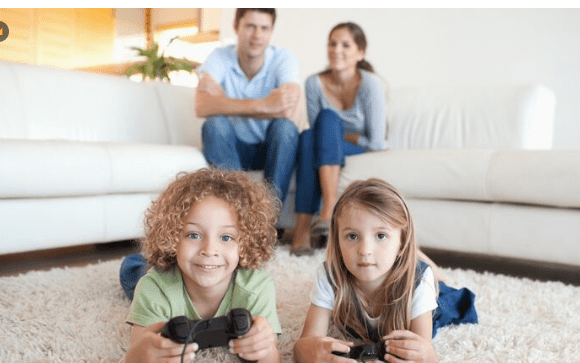
All of this does not imply that active games are useless or that parents who employ them are seriously misguided. They are one tool among many, and they are preferable to the completely inactive option on rainy days or at times when organizing outdoor play is truly challenging. The idea that parents who provide their kids with active games have found a clear solution to the conflicting demands of digital engagement and physical health is the problem. The research refutes that perception. This is not a shortcut. Regardless of what is also happening on the screen, the outdoor time, the unstructured play, and the actual physical challenge still need to occur, independently and consistently.
