

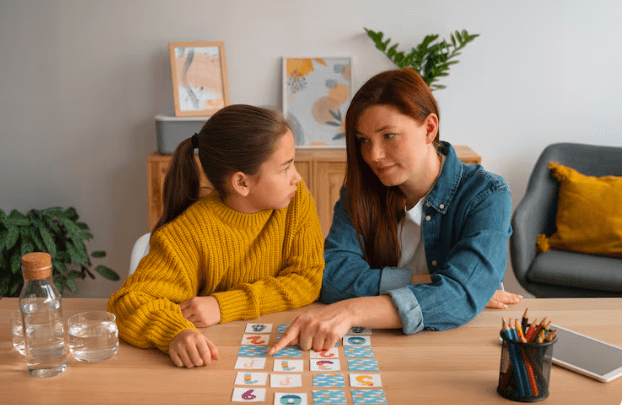
The ideal scenario involves a parent and child sitting side by side on the floor with a tablet between them. The parent points at the screen and asks, “What color do you think that is?” The child responds, and the two of them play an alphabet game together while the parent makes a connection between the letter on the screen and the letter on the cereal box they saw during breakfast. Joint media interaction is the term used by child development researchers to describe this. According to pediatric standards, children between the ages of two and five should get screen time that is “co-viewed with a parent or caregiver.” According to the majority of parents who have read those instructions, it is something that occurs infrequently at best and not at all most of the time.
There is a significant enough discrepancy between the guideline and reality that it ought to be discussed more frequently. Researchers have repeatedly found that co-viewing is the factor that determines whether children’s screen time results in learning outcomes; watching the identical content alone or with an involved adult creates measurably different consequences. What the screen cannot offer are responsive context, a link to the child’s real-world experiences, and the back-and-forth that transforms passive reception into something more akin to true learning. This is a proven fact. Practically speaking, it’s also challenging to maintain continuously in a home with a child and an active adult life.
The primary purpose of screens in the daily routines of young children is nearly always to provide uninterrupted time. That’s an honest explanation of what screens do and why they’re helpful, not a confession of parental failure. When the toddler is busy, the parent can finish a chore, make a phone call, or just have five minutes of non-demanding time. That is made feasible by the tablet. It is pointless to sit next to the child to co-view. “Time the parent has recovered” is transformed back into “time the parent is actively spending on childcare.” It is impossible for both to be true at the same time.
The issue with the app’s design adds a layer that is rarely discussed when discussing co-viewing. The majority of instructional apps for kids are designed with just one user in mind. The interface is designed with little hands in mind. One child’s individual progress is stored in the account structure. Frequently, there isn’t enough room on the tablet for two individuals to interact comfortably at the same time. Instead of encouraging group exploration, the mechanisms reward individual completion. These are not mistakes; rather, they show how the things are really utilized. Products optimized for solo usage have been sold with rhetoric about educational benefits that suggests adult engagement by developers who are building for how parents actually behave.
This circle is closed by the “educational” designation. Because the content has a developmental claim, it enables parents to believe that screen time spent alone is still beneficial. The word on the product description proactively manages the guilt that could otherwise lead a parent to sit down with the child. The parent has offered an educational material, thus they haven’t failed to co-view. The distinction between these frames for the same behavior is primarily psychological rather than experiential. Instead of understanding the underlying idea that the game’s mechanics were intended to teach, the child is still sitting by themselves with a tablet.
In reality, most houses fall halfway between tech support and passive monitoring. To make sure the content seems age-appropriate, parents listen from a nearby room. When the child is unable to find the next level, an advertisement arrives, or the Wi-Fi disconnects, they step in. The co-supervision position, which is warmer than solo viewing but isn’t what the research finds to be the most beneficial component, is partially taken on by older siblings. Occasionally, in passing, the parental engagement that was meant to connect the digital and real worlds occurs when the parent passes by the room and observes something noteworthy.
